

The lithium market has had its ups and downs over the past few years, but one theme has remained constant. The United States government is very interested in developing domestic sources of this mineral, which plays a key role in energy storage and battery systems for large grid-scale energy storage systems, electric vehicles, smartphones, and laptops. Australia, China, and Chile dominate current global lithium production while the U.S. provides less than 1% of its own demand.
There is only one active producing mine in the U.S., the Silver Peak Lithium Mine in Clayton Valley, Nevada. Albemarle Corporation (NYSE: ALB) owns the brine-based operation, which has been in continuous operation since 1965. Other projects are in development, including the most famous one: the Thacker Pass lithium mine in Nevada. Thacker Pass is a joint venture between Lithium Americas (NYSE: LAC) and General Motors (NYSE: GM), with a 5% stake financed by the U.S Department of Energy. When the country’s largest automaker and the federal government both invest in domestic lithium production, you know it’s a priority.
Still, the Department of Energy forecasts that through 2035 lithium is both the most important material for energy independence/production and one of the most at risk for a secure supply. Clearly, more domestic lithium sources are needed to meet rising demand.
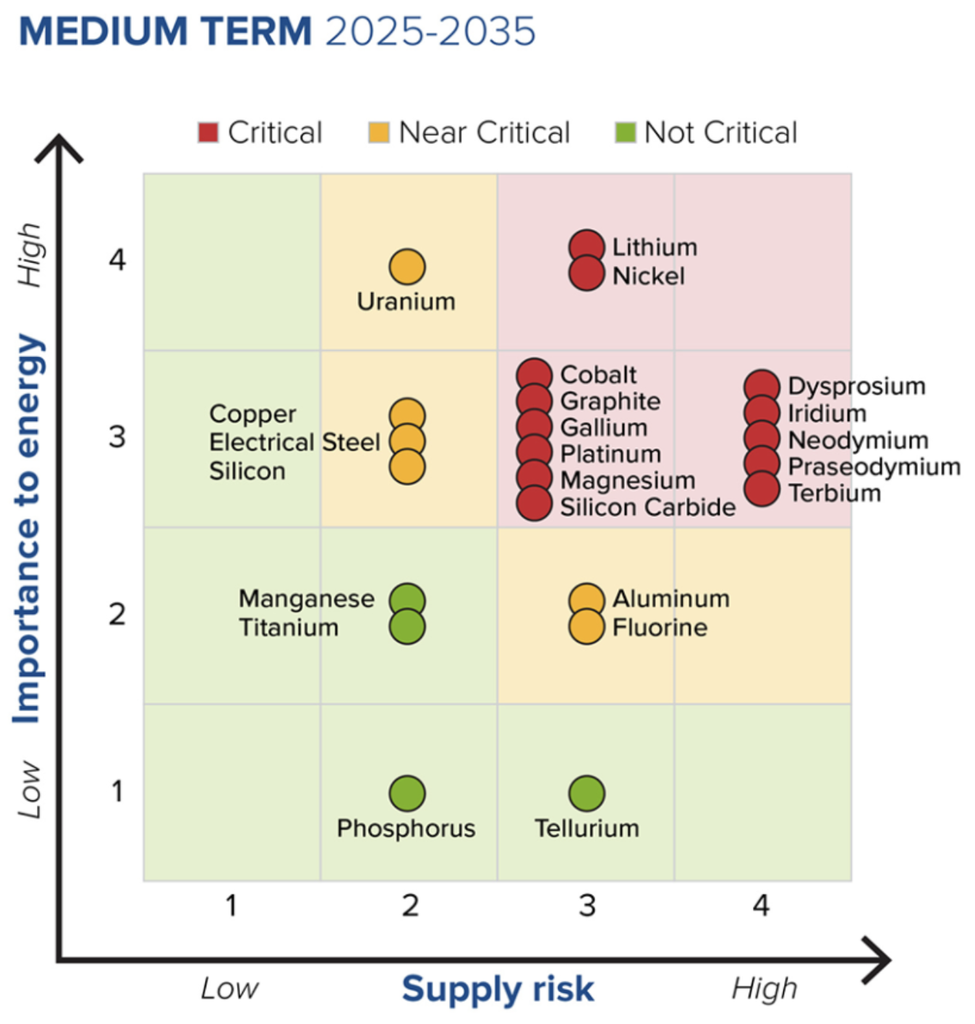
Source: DOE Critical Materials Assessment
Here we’ll focus in particular on one U.S. lithium deposit that stands out as highly undervalued: the Zeus Project, owned by Noram Lithium Corp. (TSXV: NRM) (OTCQB: NRVTF). The sediment-based project is located in the Clayton Valley, about a mile from Albemarle’s Silver Peak brine operation.
Noram’s current Mineral Resource Estimate, published in 2024, includes roughly 586 million tonnes of measured and indicated material grading 957 ppm lithium, containing approximately 3.0 million tonnes of LCE, and roughly 300 million tonnes grading 861 ppm containing about 1.4 million tonnes of inferred LCE. Within the broader deposit is a 166 million tonne higher-grade core averaging approximately 1,121 ppm lithium. This resource estimate is based on a total of 91 holes drilled on the property – one of the most extensively drilled projects in the Clayton Valley and providing for a high confidence resource.
It’s a sizable resource, yet Noram’s market capitalization is about $4.5 million, with the shares trading around $0.05.
Where Zeus Stands Now
A Preliminary Economic Assessment was completed for Zeus in 2021, but new drilling and modeling provided the foundation for Noram’s most recent MRE. Based on that estimate, the company is expecting a revised PEA to be finished this fall.
The old PEA returned some compelling numbers. Using a lithium carbonate price of just $9,500 per tonne, the project generated an estimated after-tax net present value of $1.299 billion, a 31% internal rate of return, and a payback period of 3.2 years. The break-even price for the operation was calculated at $4,016.60/tonne. This base case outlined a 40-year mine life reached through 11 phases, but the report indicated the mine plan is capable of 190 years of production. Annual production was forecast to be 5,971 tonnes/year of LCE. This is roughly equivalent to the annual production from Silver Peak.
The PEA included a price sensitivity analysis (page 109) that contemplated prices up to $14,250/tonne. At that level, net present value hit $2.665 billion and the internal rate of return hit 52%. The new PEA will be using a $24,000/tonne price as a base, in line with the figures currently used by peers in the industry. It is probably reasonable to expect the updated PEA to return significantly improved numbers based on the price increase alone.
Some Comparables
Let’s take a look at two other lithium exploration projects in Nevada and compare them to what we know about Zeus.
Century Lithium – Angel Island Project
Century Lithium Corp. (TSXV: LCE) (OTCQX: CYDVF) owns the Angel Island Lithium Project, directly bordering Noram’s Zeus property. The company’s updated Feasibility Study was announced in February 2026 and uses a base lithium carbonate price of $24,000/tonne for its economic assumptions. The resource and reserve estimates are based on 45 drill holes total on the project. Overall, the resource includes about 5.9 million tonnes of LCE measured and indicated, along with another 0.8 million tonnes inferred.
Comparing these numbers to Noram’s is interesting. Noram has drilled to a much greater extent, 91 holes to 45. This could indicate a greater density of exploration and confidence in the deposit for Noram, as Chairman Sandy MacDougall stated in this press release from February 2026 when he generally referenced the amount of drilling done by peers. The LCE resource total (measured, indicated, and inferred) is about 6.9 million tonnes for Angel Island, and about 4.4 million tonnes for Zeus.
Meanwhile, Century’s study delivers a $4.01 billion net present value with a 27.4% internal rate of return at a lithium price of $24,000/tonne. Those numbers go down to $2.75 billion and 22.2% at $18,000/tonne. Noram’s 2021 study showed a $1.299 billion net present value and a 31% rate of return at $9,500/tonne lithium price. It will be very interesting to compare these numbers after the new Zeus PEA is published using the same $24,000/tonne lithium price, but the economics, with what we know now, seem fairly comparable and attractive considering the scale of each project.
For reference, Century Lithium trades at a market capitalization of about $33 million, while Noram sits around $4.5 million. Century’s valuation is a little over 7x that of Noram, while its deposit is a little over 1.5x that of Noram.
Surge Battery Metals – Nevada North Lithium Project
Surge Battery Metals (TSXV: NILI) (OTCQX: NILIF) is focused almost exclusively on its Nevada North Lithium Project, owning a 67.5% controlling interest in the joint venture with Evolution Mining, an Australian major, holding the other 32.5%. It’s a significantly larger deposit than Zeus. The project’s most recent Mineral Resource Estimate is based on 37 drill holes and showed 10.51 million tonnes LCE in the measured and indicated categories, with another 3.11 million tonnes inferred.
The company is in the process of authoring a Pre-Feasibility Study that will incorporate the recent MRE and update the PEA that was released in 2025. That study used a $24,000/tonne lithium price for its base assumptions. Net present value came in at $9.17 billion with an internal rate of return at 22.8%.
Compared to Zeus and its ~6,000 tonnes/year LCE production level, the Nevada North project is on another scale with ~86,000 tonnes/year anticipated or about 14x production. Surge’s project is also a bit further along the development curve with the Pre-Feasibility Study in process. Still, owning two-thirds of Nevada North has the Surge Battery market cap around $136 million, or about 30x that of Noram Lithium.
Investor Takeaway
Based on the size and certainty of the resources mentioned above, it certainly appears that Noram Lithium is undervalued as the company stands right now. The outdated PEA shows attractive economics based on a $9,500/tonne LCE price assumption, while peers with Nevada-based lithium projects are using $24,000/tonne and trading at much higher multiples to the size of their resources. The economics of Noram’s pending PEA, which will be updated to match the current assumptions in the industry, are very likely to look even better when the base price is increased 2.5x.
So investors looking for value in the domestic U.S. lithium market face a choice. You can either wait for the potential re-rating of Noram’s stock when the PEA is published, or you can take advantage of the opportunity prior to that catalyst. Truthfully, it would be hard for a company with significant lithium resources in the U.S. to be valued lower at this point.
Disclaimer: TDM Financial has prepared this editorial for general information purposes only and should not be considered a solicitation to buy or sell securities in the companies discussed herein. The information provided has been derived from sources believed to be reliable but cannot be guaranteed. This editorial does not take into account the readers investment criteria, investment expertise, financial condition, or financial goals of individual recipients and other concerns such as jurisdictional and/or legal restrictions that may exist for certain persons. Recipients should rely on their own due diligence and seek their own professional advice before investing. TDM Financial has received compensation from Noram Lithium Corp. in connection with the preparation and distribution of this editorial.