
There’s a stretch of tundra about 60 kilometers north of Nome, Alaska, that the United States Geological Survey has confirmed holds the largest known graphite deposit in the country, and one of the largest anywhere in the world. It is appropriately named the Graphite Creek Project. The company that owns it, Graphite One (TSXV: GPH / OTCQX: GPHOF), trades at roughly $0.60 per share with a market capitalization near $125 million. That’s down about 57% from where it started the year, when shares traded around $1.40.
Meanwhile, the fundamental case for a higher valuation has arguably gotten stronger over those same nine months. Let’s take a look at the big picture.
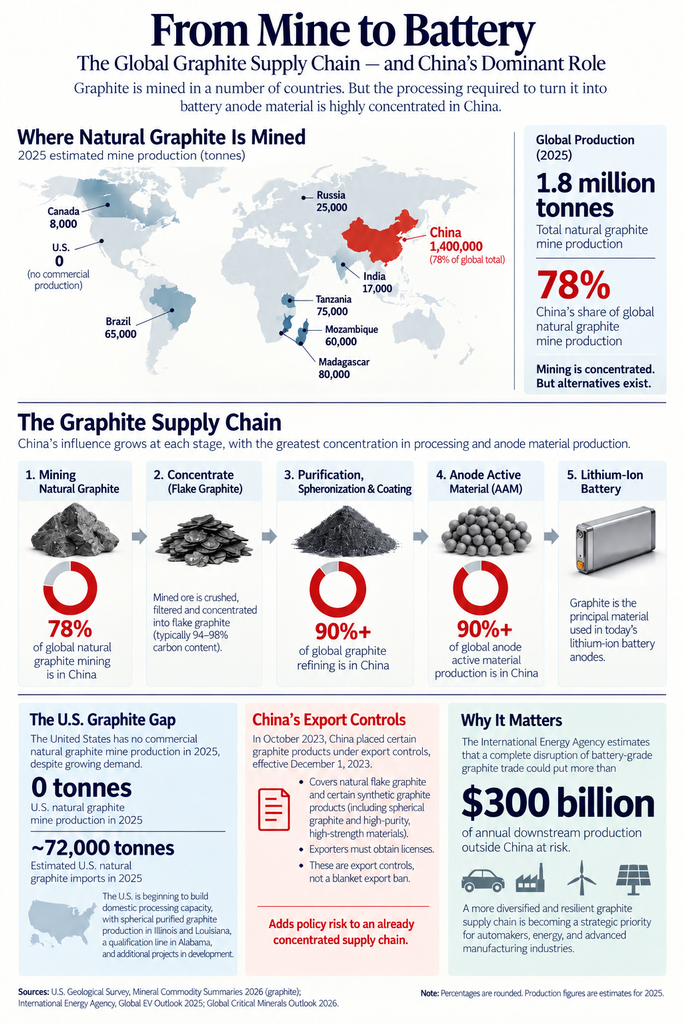
Zero. That’s How Much Graphite America Produced Last Year.
The United States imported 100% of its natural graphite in 2025, about 72,000 tonnes worth. Not most of it. All of it. For a mineral that sits at the heart of every lithium-ion battery anode and is key to energy storage systems, in an era where Washington has decided supply chain independence is a national security priority, that’s a remarkable vulnerability.
Alaska Governor Mike Dunleavy put the scale and importance of the project in perspective earlier this month, stating that new estimates suggest Graphite Creek alone could meet the entire nation’s graphite needs for a century. That’s a politician’s framing, but the underlying resource numbers support the general idea.
Graphite One’s updated feasibility work showed proven and probable reserves increasing 317% over the prior preliminary feasibility study, with measured and indicated resources up 322%. The 2022 Pre-Feasibility Study had contemplated 53,000 tonnes/year production while the 2025 Feasibility Study foresees 175,000 tonnes/year over a 20-year mine life. All of this is based on drilling that covered approximately 13% of the geophysical anomaly.
Graphite Creek is guided for a 2029 startup, targeting full production by late 2030. The mine at full capacity would supply more than two times the current level of U.S. natural graphite needs.
What Graphite One is building, though, isn’t just a mine. Not only is graphite mining non-existent in the United States, but so is the production of battery-grade materials processed from that ore.
Alaska Digs It, Ohio Refines It
The company’s plan is vertically integrated across the continent. Graphite Creek in Alaska handles mining and initial processing. Material moves out through the Port of Nome. Then it travels to Conneaut, Ohio, where Graphite One is in the process of developing an Active Anode Materials (AAM) facility.
This strategy is essential because raw graphite isn’t what battery manufacturers actually buy. They buy processed anode material, and that processing capacity has been overwhelmingly concentrated in China for two decades. While China mines almost 80% of the world’s graphite, it refines well over 90% of the world’s battery-ready graphite materials. The USGS found that the U.S. imported about 39,000 tonnes of graphite AAM (both natural and synthetic) in the first 8 months of 2025, compared to about 25,000 tonnes for the same period in 2024. Demand certainly appears to be increasing.
A U.S. mine that ships concentrate to Asia for refinement solves considerably less of the strategic problem than a mine plus a domestic refinery does. Graphite One understands this, which is why the Ohio facility is arguably as important to the thesis as the Alaska piece.
Progress there has been real. The Ohio EPA accepted the air permit application for Conneaut as administratively complete in July 2026, moving the application into technical review. The company signed an engineering contract for the facility in June 2026. The site is conveniently located with rail and port access, existing power infrastructure, including an on-site substation, and capacity for future expansion and scaling.
The company is targeting roughly 10,000 tonnes/year of synthetic AAM production by the fourth quarter of 2027, scaling toward 48,000 tonnes/year by the fourth quarter of 2028. By 2031, with Graphite Creek mine potentially providing the full supply of natural graphite, total AAM production at Conneaut is expected to reach 169,000 tonnes/year, more than three times the level of U.S. imports in 2025.
The $2 Billion Question
Now for the part that separates Graphite One from the crowded field of speculative critical minerals developers.
The company has identified approximately $2.07 billion in potential financing going forward, based on updated Letters of Interest from the Export-Import Bank of the United States, with the money split between the mine and the AAM production facility. The financing would qualify for a 15 year repayment arrangement under EXIM’s Make More in America Initiative.
Graphite One has also received two grants from the Department of War. One was issued under Defense Production Act authority for $37.3 million to accelerate completion of the company’s Feasibility Study. The other is from the Defense Logistics Agency to the tune of $4.7 million to develop an environmentally-friendly graphite-based foam fire fighting material. It also became the first Alaska mining project ever accepted onto the FAST-41 federal permitting dashboard, in June 2025.
That’s an unusual amount of federal attention for a company this size.
How to Actually Think About This
Graphite One is best understood as a policy-driven option on American critical minerals reshoring rather than as an operating business you’d value on cash flows. The asset is genuinely world-class and the government support, both federal and state, differentiates Graphite One from the vast majority of junior mining companies. Meanwhile, the company’s plan to address both the supply of graphite concentrate and the processing of finished battery materials puts the project into a different category altogether.
Consider this an introduction to Graphite One. There is much more to the story and we will be communicating that over the next few months. Investors are encouraged to do their own deep dives into the opportunity, and watch for continued progress as the company pursues its vertically-integrated plan to potentially secure domestic production of this critical mineral.
Disclaimer: TDM Financial has prepared this editorial for general information purposes only and should not be considered a solicitation to buy or sell securities in the companies discussed herein. The information provided has been derived from sources believed to be reliable but cannot be guaranteed. This editorial does not take into account the readers investment criteria, investment expertise, financial condition, or financial goals of individual recipients and other concerns such as jurisdictional and/or legal restrictions that may exist for certain persons. Recipients should rely on their own due diligence and seek their own professional advice before investing. TDM Financial has received compensation from Graphite One Inc. in connection with the preparation and distribution of this editorial.