

A few years ago, lithium was the darling of the global investment market. Electric vehicles and their lithium-ion batteries were going to take over the world, China controlled the market, car makers were investing in lithium mine developers and signing offtake agreements, and the commodity price basically tripled previous all-time highs.
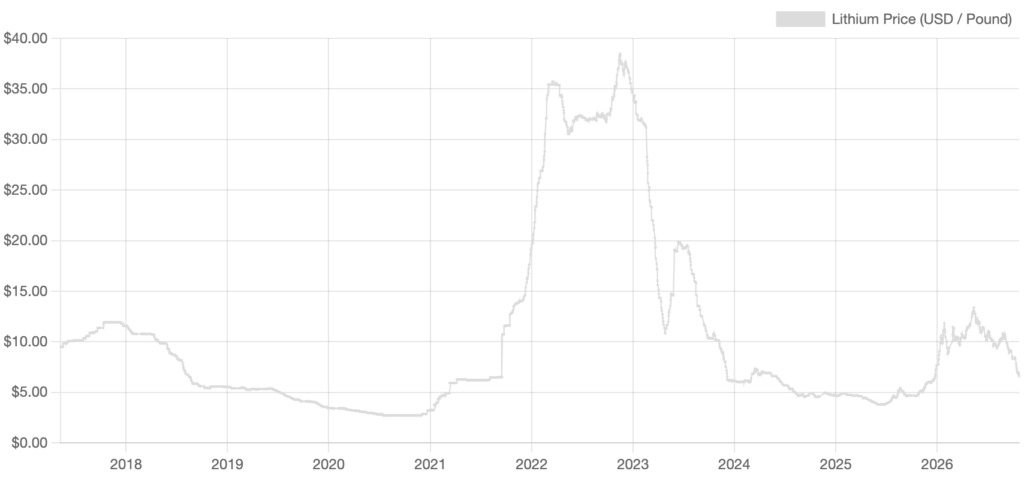
Source: Daily Metal Prices
Then it all came crashing down in 2023. EV sales didn’t boom as much or as suddenly as predicted, global production ticked up, and prices tumbled right back down to pre-pandemic levels. The narrative shifted and the money went elsewhere.
There is little doubt that the future of the lithium market will include similar narrative shifts and price fluctuations. Already this year lithium carbonate spot prices have shot higher and settled back down. But the truth is that the overarching investment case going forward looks a lot more like the bull case of four years ago than it does the bear case of the last two years.
Why A Longer Term Outlook is Needed
A recent report from Benchmark Mineral Intelligence underscores that dynamic and shines a light on the value of lithium exploration companies. The headline? Lithium industry needs the equivalent of 134 new mines by 2050 to meet growing demand. The research shows demand for lithium carbonate equivalent (LCE) increasing about 227% by 2050, and this is the company’s base case scenario. The upside case contemplates the need for more than 180 new mines. The base case calls for an average of more than five new mines/year, while the upside case is upwards of seven.
This is a global forecast, but the United States and its world’s largest economy plays a huge role in the increasing demand. And the U.S. government is employing a broad, interagency approach to manifesting domestic lithium development.
If you’ve been paying attention to the space, you know that the U.S. only has one operating lithium mine, Albemarle’s Silver Peak Lithium Mine in Clayton Valley, Nevada. Some projects are in the works, but the yawning gap between American supply and demand gives plenty of room for other opportunities. Given the projections of unrelenting demand for new lithium sources and the potential upside inherent in long-term resource advancement, investors might be wise to look beyond existing producers in search of the next mine-worthy deposits.
Nevada’s Proven Neighborhood
A good place to start looking for potential future lithium mines might be the place where one already exists: the Clayton Valley in Nevada. About a mile away from the Silver Peak Lithium Mine you’ll find the Zeus Project, owned by Noram Lithium Corp. (TSXV: NRM) (OTCQB: NRVTF).
Noram’s current Mineral Resource Estimate, published in 2024, includes roughly 586 million tonnes of measured and indicated material grading 957 ppm lithium, containing approximately 3.0 million tonnes of LCE, and roughly 300 million tonnes grading 861 ppm containing about 1.4 million tonnes of inferred LCE. Within the broader deposit is a 166 million tonne higher-grade core averaging approximately 1,121 ppm lithium. This resource estimate is based on a total of 91 holes drilled on the property – one of the most extensively drilled projects in the Clayton Valley and providing for a high confidence resource.
It’s a sizable resource, yet Noram’s market capitalization is just under $4 million, with the shares trading around $0.04.
A Preliminary Economic Assessment was completed for Zeus in 2021, but new drilling and modeling provided the foundation for Noram’s most recent MRE. Based on that estimate, the company is expecting a revised PEA to be finished this fall.
The old PEA returned some compelling numbers. Using a lithium carbonate price of just $9,500 per tonne (for reference the current price is about $15,000 per tonne), the project generated an estimated after-tax net present value of $1.299 billion USD, a 31% internal rate of return, and a payback period of 3.2 years. The break-even price for the operation was calculated at $4,016.60/tonne. This base case outlined a 40-year mine life reached through 11 phases. Annual production was forecast to be approximately 31,900 tonnes/year of LCE. This is roughly equivalent to the annual production from Silver Peak.
The new PEA will be using a $24,000/tonne price as a base, in line with the figures currently used by peers in the industry. For example, Century Lithium Corp. (TSXV: LCE) (OTCQX: CYDVF) owns the Angel Island Lithium Project, directly bordering Noram’s Zeus property. The company’s updated Feasibility Study was announced in February 2026 and uses a base lithium carbonate price of $24,000/tonne for its economic assumptions. Century submitted its Mine Plan last month. It is entirely possible that Noram’s updated PEA could return significantly improved numbers based on the price increase alone.
Investor Takeaway
Noram has a sizable deposit on its hands, extensively drilled, in an area that has proven it can support lithium production. This is not a stake in the ground out in the wilds sort of project where if you squint really hard you might be able to imagine an actual mine someday far in the future. Zeus sits squarely in one of the world’s best mining jurisdictions (Nevada), on ground known to have lithium reserves, surrounded by the infrastructure needed to build and run a real world mine.
The distance between the project as it stands right now and the potential for eventual lithium production on the site seems a lot smaller than the gap between Noram’s miniscule market capitalization and the actual value of a large lithium deposit situated as Zeus is. This is a stand-alone idea, but when you combine it with the geopolitical backdrop of the United States’ efforts to develop extensive domestic sources of lithium, Noram’s valuation looks even more nonsensical.
Disclaimer: TDM Financial has prepared this editorial for general information purposes only and should not be considered a solicitation to buy or sell securities in the companies discussed herein. The information provided has been derived from sources believed to be reliable but cannot be guaranteed. This editorial does not take into account the readers investment criteria, investment expertise, financial condition, or financial goals of individual recipients and other concerns such as jurisdictional and/or legal restrictions that may exist for certain persons. Recipients should rely on their own due diligence and seek their own professional advice before investing. TDM Financial has received compensation from Noram Lithium Corp. in connection with the preparation and distribution of this editorial.