


Rocket Doctor AI’s (CSE: AIDR) (OTCQB: AIRDF) second-quarter revenue barely moved from the first quarter, but its U.S. patient volume told a much more encouraging story.
The digital healthcare company reported C$734,028 in second-quarter revenue, down slightly from C$737,103 in the first quarter. Revenue increased 43% from a year earlier, but sequential growth, which is the more relevant measure for a company investing heavily in expansion, was effectively zero. Completed U.S. patient visits, meanwhile, surged 196% to 3,911 from 1,319 in the prior quarter.
The widening gap between patient volume and reported revenue could make the quarter considerably better than the income statement suggests. Rocket Doctor recognizes its U.S. patient revenue when payment is actually received because of uncertainty surrounding Medicare, Medicaid, and private insurance collection timelines. Higher patient volumes therefore don’t necessarily appear as revenue during the quarter when care is delivered.
Management expects the increase in visits to flow through the financial statements in future quarters. The next few earnings reports should provide an important test of whether the rapidly growing U.S. operation can materially change Rocket Doctor’s financial profile.
Patient Volume Is Starting to Scale
Rocket Doctor has spent much of the past year building the infrastructure needed to become an in-network healthcare provider rather than simply another telehealth platform.
The company now reaches approximately 24 million covered lives across California, New York, and Maryland, up from roughly 21 million at the end of the first quarter. Its active U.S. clinician network increased to 30 providers during the second quarter from 19, while Rocket Doctor has 80 providers on its broader roster, most still moving through credentialing.
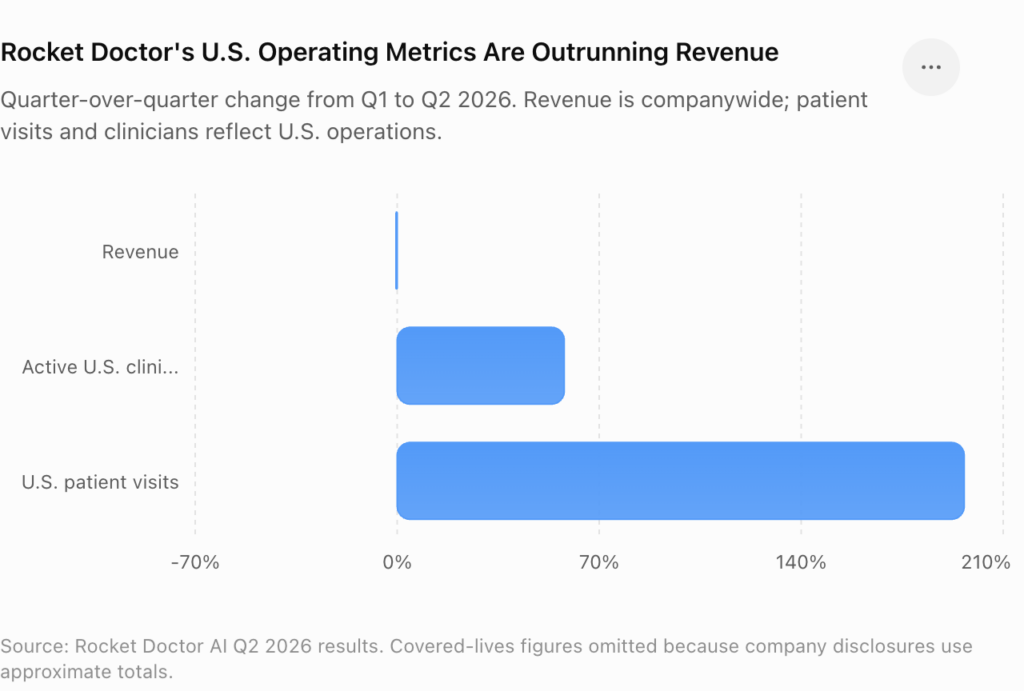
Patient utilization is beginning to follow the network expansion. U.S. visits nearly tripled sequentially during the second quarter after rising sharply during the first quarter, providing stronger evidence than covered-life figures alone. An insurance contract has limited economic value until eligible patients begin using the service.
Rocket Doctor still has a long way to go. Fewer than 4,000 U.S. visits during an entire quarter remain modest relative to a potential population measured in the tens of millions, and triple-digit growth is easier to achieve from a small base. The direction is nevertheless encouraging: Rocket Doctor appears to be converting payer access into actual patient activity. The next step is converting patient activity into meaningful revenue.
A More Attractive Revenue Model
Rocket Doctor is also moving beyond episodic virtual visits, potentially improving both the quality and predictability of its revenue.
In June, the company signed its first U.S. value-based primary-care agreement. The arrangement enables physicians using Rocket Doctor’s platform to manage assigned patient panels, establishing recurring primary-care relationships rather than relying entirely on individual virtual visits. A related specialty-services agreement provides access across nine payers and 65 insurance products.
“This agreement represents another important evolution in our U.S. strategy,” said Rocket Doctor Inc. CEO William Cherniak, describing the opportunity as a “scalable framework for recurring primary care relationships.”
Recurring primary-care relationships could generate more predictable economics, improve patient retention, and increase the amount of care delivered through Rocket Doctor’s platform. Value-based arrangements could also move the business further away from competing as a commodity telehealth provider.
Management’s comments regarding another recent partnership point toward the same objective. Discussing an expanded New York program in July, Cherniak said, “Our focus now is on creating sustainable reimbursement pathways that will allow this model to grow.”
Sustainable reimbursement is arguably the most important phrase in Rocket Doctor’s recent releases. Patient reach and visit growth demonstrate demand, but reimbursement ultimately determines whether the growing network creates shareholder value.
The company has continued expanding its distribution since the quarter ended. An August agreement in California opened another pathway across commercial healthcare, Medicare Advantage, workers’ compensation, and auto-medical channels through a national network serving more than 700 health plans and roughly 60 million consumers. The figure represents the broader network’s reach rather than 60 million new Rocket Doctor patients, but the agreement substantially broadens the channels through which Rocket Doctor can pursue reimbursed care.
Can More Revenue Stop the Burn?
Rocket Doctor’s growth story still carries a significant financial constraint.
The company posted a C$6.67 million net loss during the second quarter, compared with C$4.64 million in the first quarter. Adjusted EBITDA deteriorated to negative C$4.12 million from negative C$2.98 million, while cash and equivalents totaled just C$950,000 at the end of June.
Rocket Doctor subsequently raised approximately C$3.26 million through an oversubscribed convertible-debenture financing. The additional capital gives management more room to execute its U.S. strategy, although the securities carry potential dilution for existing shareholders.
Current spending becomes considerably easier to justify if U.S. reimbursement begins catching up with patient growth over the next several quarters. Continued losses at the current level without a substantial increase in revenue would leave Rocket Doctor dependent on additional outside capital.
Gross margin also deserves context. It declined to 65% from 75% in the first quarter and 89% a year earlier, but the deterioration doesn’t necessarily signal worsening underlying economics. As Rocket Doctor consolidates its U.S. practice group, payments to physicians are recorded as direct costs alongside corresponding revenue, mechanically reducing the reported gross-margin percentage as U.S. patient volume grows.
Investors should therefore watch absolute gross profit and operating leverage alongside the headline margin percentage. The more consequential question is whether incremental U.S. volume eventually generates enough platform economics to narrow Rocket Doctor’s substantial operating losses.
The Next Few Quarters Matter
Rocket Doctor’s second quarter provides a useful dividing line for investors. The company spent much of 2025 and early 2026 building payer relationships and clinical capacity, and patient utilization is now increasing quickly enough to test whether the strategy can produce meaningful financial results.
A successful second half would include continued U.S. visit growth accompanied by a much more visible increase in recognized revenue. Progress in recurring value-based-care arrangements would strengthen the case further, particularly if operating expenses begin growing more slowly than patient volume and gross profit.
Rocket Doctor remains a speculative healthcare growth company with substantial financing risk. Its operating trajectory is becoming harder to dismiss, however, as payer access, clinician capacity, and patient utilization move in the same direction.
Flat second-quarter revenue obscures much of the progress underway in the U.S. business. Rocket Doctor has largely built the network; the investment case increasingly depends on how efficiently it can monetize it.
Author’s Disclosure: This article reflects the author’s independent analysis and personal views. The content is provided for informational purposes only and should not be considered financial or investment advice. Readers are encouraged to conduct their own independent research and due diligence before making any investment decisions.