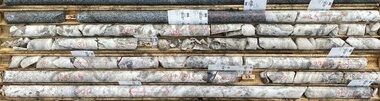


South Pacific Metals (TSX-V: SPMC) (OTCQB: SPMEF) does not have a scale problem at its Kili Teke project. The Papua New Guinea copper-gold property already hosts an NI 43-101 Inferred Mineral Resource of 237 million tonnes grading 0.34% copper and 0.24 grams per tonne gold along with 0.017% molybdenum. That represents approximately 802,000 tonnes of copper, 1.81 million ounces of gold and 40,000 tonnes of molybdenum—or roughly 4.2 million gold-equivalent ounces using the company’s current assumptions.1
For an exploration-stage company, this is a substantial starting point. Yet it may not even be the most exciting part of Kili Teke, with significant near-surface high-grade targets emerging from historic data compilation and recent field work.
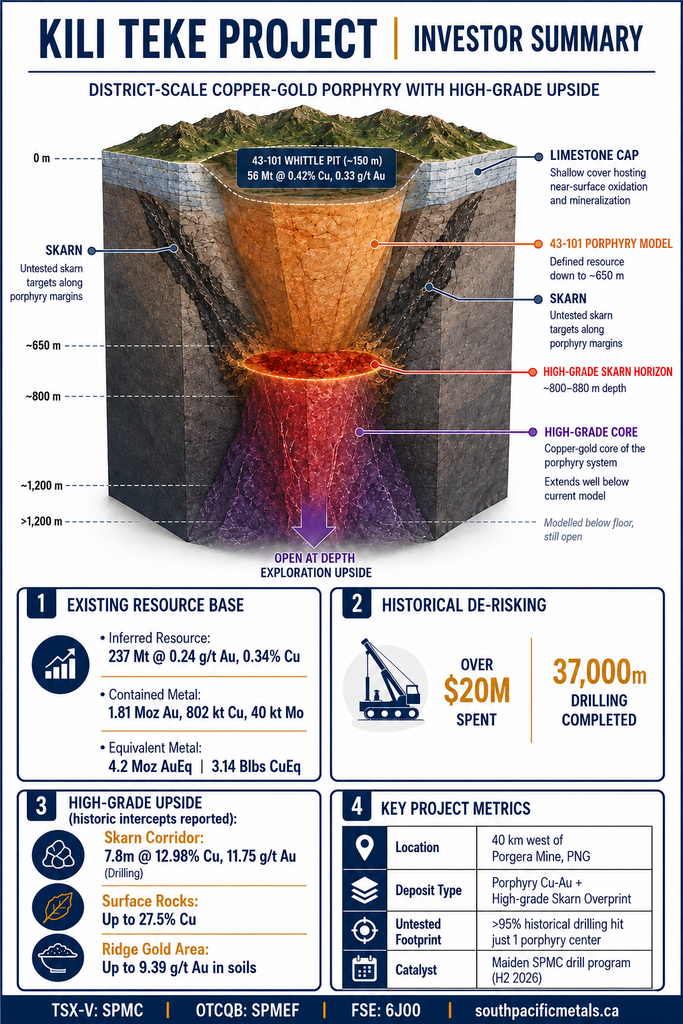
Most historical drilling across the 253-square-kilometer property focused on the Central Main Porphyry hosting the resource. South Pacific now has crews on the ground for its first company-led field program, looking around that deposit for higher-grade copper and gold in the near surface.
That makes Kili Teke different from a typical early-stage prospect. The company is not starting with a geochemical anomaly and hoping to find a mineralized system. SPMC instead starts with a large already-identified mineral system on the project and is asking whether previous operators stopped before testing, perhaps, the best targets.
A Resource Built by Harmony
Kili Teke lies in Papua New Guinea’s Papuan Fold Belt, approximately 40 kilometers west of the Porgera Gold Mine and 20 kilometers northwest of another substantial gold resource at Mt. Kare. South Pacific acquired the project from Harmony Gold in 2023 after Harmony and earlier operators had completed roughly 37,000 meters of drilling.
The existing resource is entirely within the Central Main Porphyry. It represents one of those rare and sought-after panaceas in discovery – a large scale copper-gold system.
More important may be what lies outside that resource. A targeting program combining geochemistry, geophysics, three-dimensional modeling and machine learning identified multiple new targets. They broadly include deeper porphyry mineralization, high-grade copper-gold skarns’ and structurally controlled gold targets with geochemical signatures similar to Porgera.
Searching Beneath the Resource
One obvious target sits below the Central Main Porphyry. The current resource model covers the upper portion of the system, while historical holes encountered stronger copper grades at depth. South Pacific has highlighted 187 meters grading 0.62% copper and 0.44 g/t gold from 501 meters in hole KTDD022. Other selected deeper intervals included 52 meters at 1.18% copper and 0.81 g/t gold in KTDD013 and 47 meters at 1.08% copper and 0.50 g/t gold in KTDD022.
These are historical results from the prior operator, and the reported widths are downhole lengths rather than confirmed true widths. Stronger stockwork veining, machine-learning analyses, and deeper intercepts have led South Pacific to interpret the Central Main Porphyry as an upper-level system with potential for a higher-grade centre below it.
The implication is straightforward: the existing resource may represent only the upper portion of a quality porphyry system. Future drilling will determine whether grade improves consistently at depth or whether the stronger historical intervals are isolated.
Higher Grades at the Edges
Kili Teke also contains evidence of higher-grade mineralization outside the resource model. Historical drilling intersected skarn where intrusive rocks meet favorable carbonate units. A standout interval returned 8.8 meters grading 11.80% copper and 20.5 g/t gold within a broader 54 meters at 2.1% copper and 1.82 g/t gold from 878 meters downhole. This mineralization is not included in the current resource, and with the potential for bonanza grades nearer surface high-grade targets are being assessed.
In the search for bonanza zones, renewed fieldwork has added a new target west of the porphyry. In August, South Pacific reported an outcrop sample grading 12.8% copper, 0.30 g/t gold and 104 g/t silver from a massive-sulphide unit traced for more than 200 meters along a fault contact. While early stage and from selective rock-chip samples, these results show the strong potential outside of the porphyry resource. Upcoming drilling will test the grade and width of this and other targets in close proximity to the significant existing copper-gold resource.
The western Ieru area adds further extensional support. Historical trenching returned 132 meters grading 0.55% copper and 0.60 g/t gold, including 27 meters at 0.97% copper and 1.25 g/t gold. These results demonstrate why the surrounding ground warrants drilling.
The Porgera-Style Target
The most intriguing target may be Ridge Gold, east of the resource. South Pacific describes Ridge Gold as a possible Porgera-style alkalic epithermal system. Historical soil sampling outlined a broad and very high-tenor gold anomaly with values up to 9300ppb Au (equivalent to 9.3 g/t, in soils!), accompanied by highly anomalous tellurium and arsenic – elements associated with Porgera-style mineralization. The company believes earlier drilling may not have been oriented effectively to test the potential high-grade structures.
The comparison is attention-grabbing because Porgera, roughly 40 kilometers east, is arguably the world’s greatest alkalic gold system with both bulk tonnage mining zones, along with substantial small footprint bonanza grade zones (such as Porgera Zone 7) individually yielding millions of ounces. Porgera is a major long-life gold operation that has produced over 16 million ounces of gold since 1990. It is operated by New Porgera Ltd – a joint venture between Canada’s Barrick Mining (NYSE: B), China’s Zijin Mining Corporation and PNG stakeholders. It is one of the world’s ten largest gold mines and is ramping up to producing over 600,000 ounces annually following a restart in 2023.
Ridge Gold’s structure, alteration and geochemical signature definitely warrant a substantial drill-test to see if the theory translates into meaningful gold intercepts.
The Next Test
South Pacific already has something many junior explorers spend years trying to establish: a large mineral resource. What it does not have is a reserve, an economic study demonstrating profitable extraction or enough drilling outside the Central Main Porphyry to know whether the surrounding targets materially improve the project.
The current program is designed to narrow that gap. South Pacific expects to prepare targets for a maiden company-led diamond-drilling program at Kili Teke, with priority areas including Ieru to the west, Ridge Gold to the east and deeper targets beneath the existing porphyry. Timo Jauristo, CEO of SPMC, commented: “Kili Teke has been dormant for almost a decade, but the opportunity here was never in doubt. Our first exploration program has already found further encouraging evidence of strong mineralisation in several areas outside of historically drilled Central Porphyry. This supports our view of Kili Teke as a broader porphyry/epithermal complex around the 4.2 Moz AuEq or 3.1 billion lbs CuEq Central Porphyry. Our focus now is on pulling this recent data together with the historical dataset to define targets ready for drill testing by the end of October.”
South Pacific recently announced the closing of a C$20 million financing intended to pay for the next round of drilling and beyond. Those holes should begin answering the question that matters most. If drilling simply confirms more moderate-grade porphyry mineralization, Kili Teke will remain a large but early-stage development challenge. If it confirms higher-grade porphyry, skarn or epithermal gold outside the resource, the economics and strategic relevance of the broader system could look substantially different. The next few months have the potential to provide several catalytic events for South Pacific, stay tuned.
For more information, visit South Pacific Metals or view the company’s investor presentation.
Footnote: 1Gold-equivalent (“AuEq”) based on equal co-recovery of gold and copper using US$3,300/oz gold and US$4.45/lb copper. AuEq grade is 0.55g/t Au. Metallurgical test work indicates Au reports to a Cu concentrate. This AuEq figure is not the basis of the Mineral Resource Estimate; drawn from the independent technical report dated November 18, 2022, prepared by Graeme J. Fleming, B.App.Sc., MAIG, and available under the company’s profile on SEDAR+ at www.sedarplus.ca. Rock-chip, soil and stream-sediment results referenced in this article are selective samples and are not necessarily representative of mineralization hosted on the properties. Mineralization on adjacent or nearby properties, including New Porgera Limited, is not necessarily indicative of mineralization on South Pacific Metals’ properties.
Disclaimer: TDM Financial has prepared this editorial for general information purposes only and should not be considered a solicitation to buy or sell securities in the companies discussed herein. The information provided has been derived from sources believed to be reliable but cannot be guaranteed. This editorial does not take into account the readers investment criteria, investment expertise, financial condition, or financial goals of individual recipients and other concerns such as jurisdictional and/or legal restrictions that may exist for certain persons. Recipients should rely on their own due diligence and seek their own professional advice before investing. TDM Financial has received compensation from South Pacific Metals Corp. in connection with the preparation and distribution of this editorial.