


Telehealth, remote health, rural health, virtual health – these are all buzzwords and themes that are becoming more prominent in a world where physicians are stretched thin and patients have a hard time finding timely care. Whether the issue centers around the inconvenience of patients having to drive an hour or two just to have an initial visit, or doctors that are booked out for months in advance, or offices that are simply overwhelmed by the demands of a complex and changing regulatory environment, it’s not an easy time to be navigating healthcare.
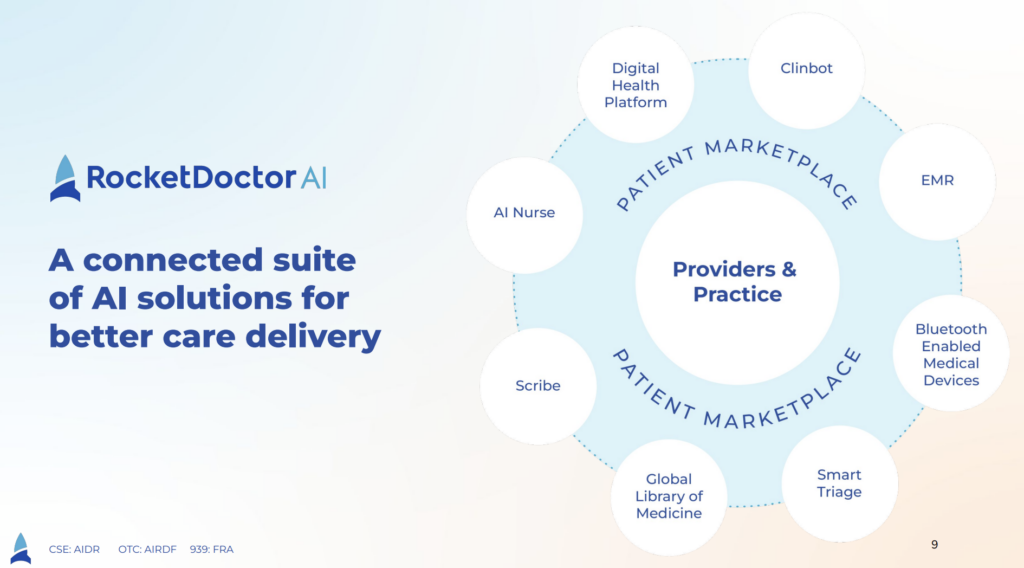
Rocket Doctor AI (OTCQB: AIRDF) (CSE: AIDR) is a Canadian-based company that offers a solution to many of these problems. Rocket Doctor has created a platform that allows physicians to set up their own virtual care business very easily, handling a lot of the backend work like electronic medical records and streamlining the intake process. For practices that spend an average of almost 2 hours daily (outside of office hours) on documentation alone, this automated system can make a huge difference.
Source: Rocket Doctor AI Investor Deck
In rural areas a platform like Rocket Doctor can have an even more pronounced effect on quality and availability of care. A virtual practice allows patients from outlying areas to consult with physicians without the commute, and gives doctors the ability to cover people across a much broader geographical area than from a strictly physical practice. Residents in remote areas of the United States in particular face increasing barriers to critical health services, with more than 200 rural hospitals completely or partially closing since 2005. According to data from The Chartis Center for Rural Health 432 rural hospitals nationwide, representing roughly 22% of the country’s rural health infrastructure, are currently operating at high risk of closure. It’s a full-blown crisis, and virtual care can help to bridge the widening gaps in the system.
Watch an informative recent interview with Rocket Doctor AI CEO Dr. Essam Hamza. He goes into detail about how the platform works, the value it adds to existing practices, its appeal to insurers, and the company’s recent expansion in key U.S. markets.
U.S. Growth
Rocket Doctor has a longer history of operations in Canada than it does in the U.S. Basically the company has proven its model with over 750,000 patients seen and more than 350 doctors using the platform across British Columbia, Alberta, and Ontario. Rocket Doctor AI used to be known as Treatment.com AI before acquiring the Rocket Doctor platform in April 2025. The combined company reported its first significant revenue in Q2 2025, all from Canada.
Having commenced the work more than 3 years ago, over the balance of 2025 Rocket Doctor has been very busy expanding into key markets in the United States. The focus is on penetrating the most complex and largest states first, like California and New York, by reaching agreements with major insurers in those states. As a result of a long list of announced deals, Rocket Doctor now offers covered services to over 21 million patients through insurance networks including Medicare, Medicaid, Humana, United Healthcare, Anthem, Aetna, and state-run programs in New York, California, and Maryland.
The plan is to continue expansion in those states as well as in other states with their established relationships with national insurers. Building on the time and focus the company has put into the market to date, it has been a very steep growth curve from zero to 21 million covered U.S. lives in less than a year, and Rocket Doctor intends to continue on that path. But the revenue picture hasn’t changed much to this point.
Converting Agreements Into Revenue
In the beginning of May, Rocket Doctor reported its FY 2025 financial results. The company clocked a 31.8% rise in revenue from Q3 to Q4, but about 97% of that revenue was from Canada. The U.S. insurer agreements began in earnest in Fall 2025, and there is an integration period and ramp-up before much revenue can be generated.
If Rocket Doctor is going to scale significantly from its ~$1.7 million in annual revenue, U.S. operations will need to be the main driver. That is why investors should look to Q1 2026 results for signs of the company’s ability to turn potential into revenue. According to Tip Ranks, Rocket Doctor is scheduled to release earnings on June 3, though it could happen before that date.
Q1 2026 will still likely reflect an engine that is just starting, and Q2 would ideally build on that. But it seems reasonable to anticipate that the signs of success in the U.S. should start to show soon, initially through increased patient visits. And the company is certainly not planning to stop at three states and 21 million potential patients. Rocket Doctor believes further expansion into other state markets is most likely for 2026 and beyond as the model is proven and enterprise partnerships grow.
As CEO Dr. Essam Hamza puts it in the interview above, “When you talk to a payer, and you show them that you are keeping this patient out of hospital, and instead of spending thousands of dollars when they go to the emergency room they are spending a hundred dollars to see a doctor on the platform, that’s huge. When you say that you can catch that patient with diabetes early on in the process instead of once they’ve had complications and cost the system a lot more money, that’s huge. When you show the number of doctors that are on the platform and are willing to see patients and are giving the patients better access to care and those are patients of that insurer, that’s huge. So that’s the selling point.”
Keep an eye out for further developments from this emerging healthcare company, and certainly watch for earnings results as Rocket Doctor’s foothold in the U.S. becomes stronger.
Sponsored Content Disclosure: This article is sponsored by Rocket Doctor AI. SECFilings.com has partnered with the company to help share its story with a broader audience of investors and industry followers. SECFilings.com is being compensated $15,000 USD per quarter by 45 Degrees Inc. While we strive to present accurate information and maintain editorial standards, this content is part of a paid awareness initiative. Please do your own research and consult a licensed advisor before making investment decisions.