


The lithium carbonate market has been in a bit of a boom/bust cycle over the past few years. Prices soared from 2021 through 2022, driven by electric vehicle (EV) sales and supply deficits accentuated by the pandemic. 2023 saw a steep decline due in part to increasing supply coupled with lower than expected EV demand. Late 2025 into 2026 has seen a significant rebound, though lately prices are starting to retrace a bit.
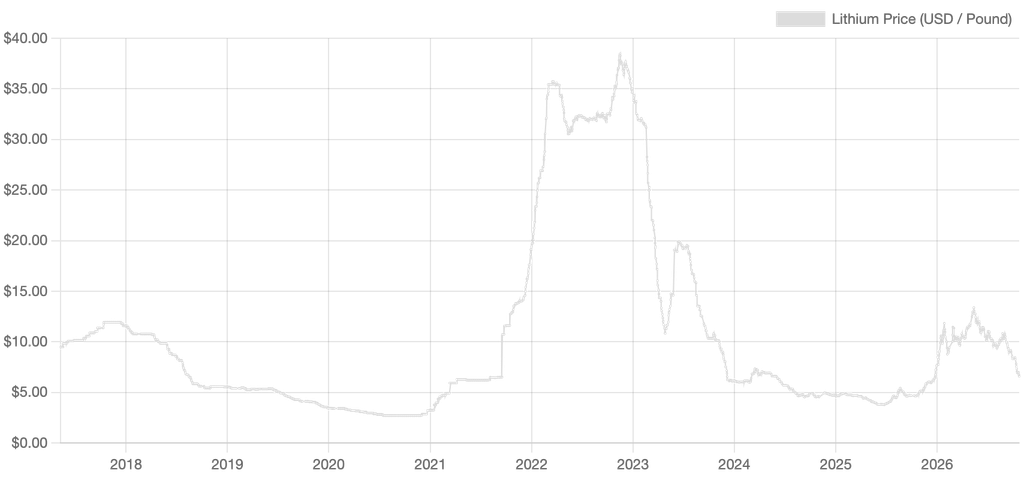
Source: Daily Metal Prices
Through it all, the long term forecast has always been that more supply is needed to meet rising demand. With the rise of data centers and battery energy storage systems (BESS) in addition to the ongoing global EV evolution, pressure from the demand side of the equation is not going away anytime soon.
A recent report from Benchmark Mineral Intelligence underscores that dynamic and shines a light on the value of lithium exploration companies. The headline? Lithium industry needs the equivalent of 134 new mines by 2050 to meet growing demand. The research shows demand for lithium carbonate equivalent (LCE) increasing about 227% by 2050, and this is the company’s base case scenario. The upside case contemplates the need for more than 180 new mines.
Mines are, of course, not created in a year or two. The development process, from discovery of a possible deposit to exploration/drilling that defines the resource through permitting and construction, takes years to unfold. And each step along the way adds value to the companies trying to shepherd projects through the cycle. Given the projections of unrelenting demand for new lithium sources and the potential upside inherent in long-term resource advancement, investors might be wise to look beyond existing producers in search of the next mine-worthy deposits.
And considering the push by the Canadian government to develop domestic sources of the critical mineral, that country’s projects are probably a good place to start looking. Canada has two producing lithium mines. More are clearly needed, and Canada is home to the world’s sixth largest volume of lithium reserves.
Canadian Potential
The province of Québec is home to one of the two operating mines, the recently re-opened North American Lithium Mine near Val-d’Or. Further north near James Bay the Whabouchi Mine is planned for restart. In between there is a whole lot of potential for lithium development based on the geology of the region and the resulting presence of Lithium-Cesium-Tantalum (LCT) pegmatite formations.
The James Bay region in particular is a hotbed for LCT pegmatite exploration. CDN Maverick Capital Corp. (CSE: CDN) (OTCQB: AXVEF) has an extensive claim package in the area, covering nearly 57,000 hectares (more than 140,000 acres) of prospective ground. CDN Maverick is a mineral-agnostic project generator and explorer, and the claims offer exposure to polymetallic VMS mineralization (copper, zinc, lead, gold, silver) as well as Ni-Cu-PGE mineralization (nickel, copper, platinum, palladium). But here we’ll focus on the lithium pegmatite potential, which is significant.
CDN Maverick’s two most active claim groups, Nottaway and Chabinoche, are considered lithium targets by the company. The Chabinoche claim is intensely focused on lithium pegmatite. The area was covered by ancient lake sediment and glacial cover which hides pegmatite rock outcroppings, and the company is currently awaiting assay results from a backpack drill program designed to hone in on the most promising targets for further exploration and deeper drilling. Backpack drilling recovers two sample types from each hole: fresh bedrock and the basal glacial till (“bottom-of-till”) sitting directly on that bedrock, giving CDN Maverick both a direct rock test and a dispersal-based vector toward pegmatite bodies the hole itself may miss.
The same program was used to explore potential lithium targets on the Nottaway claim as well. There are interesting historic drill intercepts that were basically ignored because the previous company (SOQUEM) was looking for precious metals. CDN Maverick is also looking for precious metals at Nottaway but is in no way ignoring the lithium signals present in the historic results.
Proof of Concept
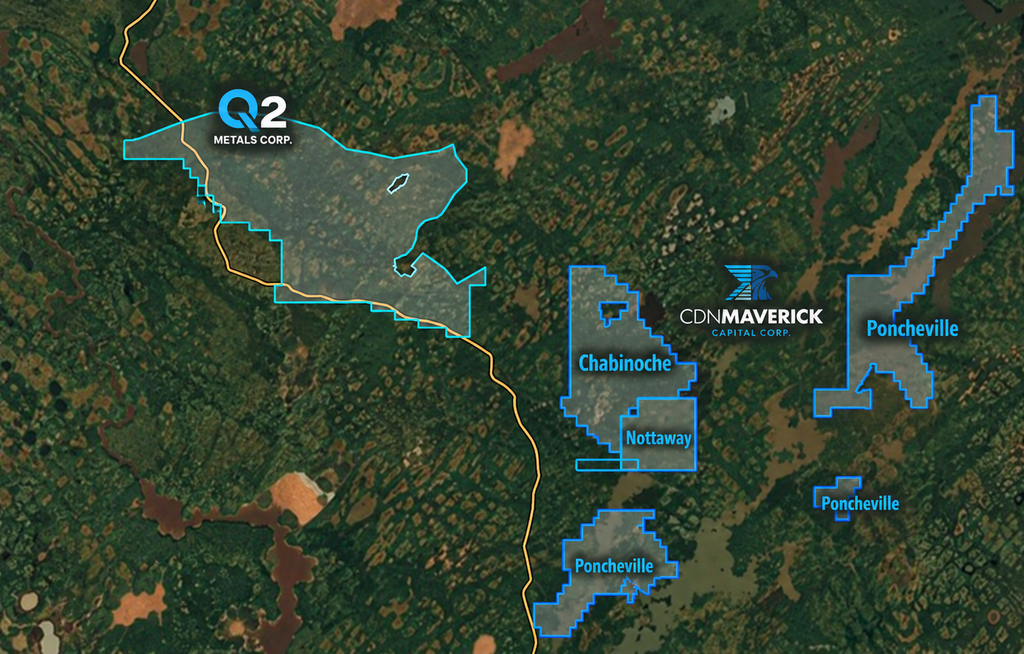
CDN Maverick’s claims are very close to Q2 Metals Corp’s (TSX.V: QTWO) (OTCQB: QUEXF) Cisco Lithium Project. The land shares the same glacial geology discussed above. Q2 acquired the Cisco claims in 2024 based on some historical data that pointed to the presence of tantalum (part of the LCT pegmatite mineral mix) and one hole drilled in 2023 that hit high grade LCT rock. At the time of the acquisition in February 2024, Q2’s stock traded around C$0.22/share. By the time of the company’s release of the maiden resource estimate in April 2026, following about 1.5 years of drilling, the stock price had appreciated to C$2.57/share.
The meteoric rise of Q2’s stock, from C$0.22 to C$2.57 (1,168% appreciation) was based on acquisition of basically one good hole and continued drilling that pointed to a large potential deposit. The resource still sits in the Inferred category, the price has settled back to the C$1.65 range and Q2’s market cap is approximately C$355 million.
If Q2 can move the Inferred resource into the highest confidence Measured category, which is not guaranteed, the deposit would rank among the world’s largest. The Q2/Cisco experience points to the type of appreciation that CDN Maverick is chasing with its current exploration program in the same geological and geographical area.
Investor Takeaway
CDN Maverick, with a market capitalization of about C$3 million, offers investors upside potential based on its lithium assets alone, not to mention the company’s other polymetallic endeavors. The demand for new sources isn’t going away any time soon, and the ability to invest at such an early stage means that investors get exposure to all of that upside at a very low price.
There are obviously risks associated with any type of investment, and we don’t pretend to be offering economic advice. But the critical minerals sector does offer the possibility of significant value creation at each stage of the development process, and the setup for CDN Maverick and its early stage lithium program is intriguing to say the least.
Disclaimer: TDM Financial has prepared this editorial for general information purposes only and should not be considered a solicitation to buy or sell securities in the companies discussed herein. The information provided has been derived from sources believed to be reliable but cannot be guaranteed. This editorial does not take into account the readers investment criteria, investment expertise, financial condition, or financial goals of individual recipients and other concerns such as jurisdictional and/or legal restrictions that may exist for certain persons. Recipients should rely on their own due diligence and seek their own professional advice before investing. TDM Financial has received compensation from CDN Maverick Capital Corp. in connection with the preparation and distribution of this editorial.